
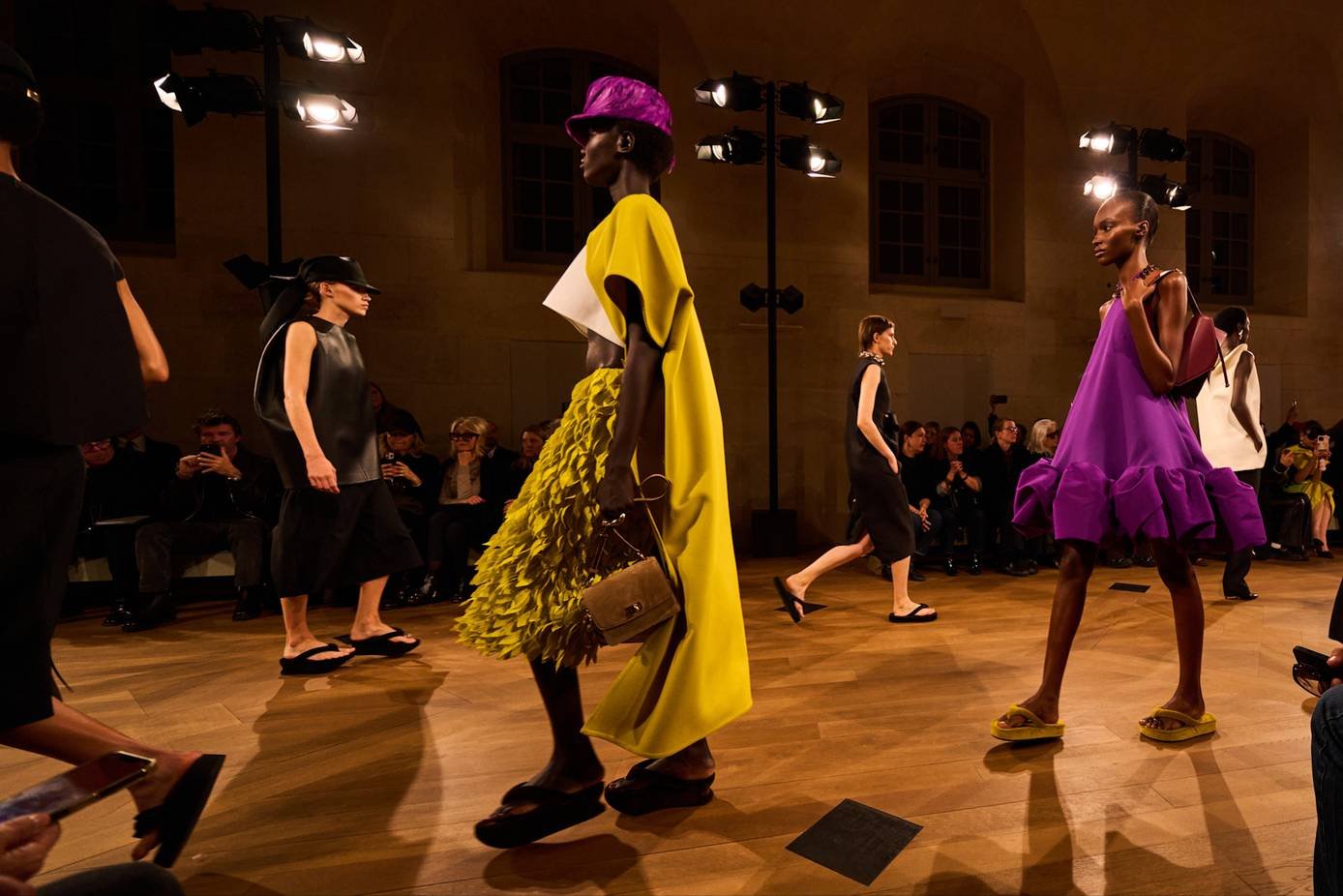
Balenciaga’s Spring/Summer 2026 show at Paris Fashion Week marked a defining moment as Pierpaolo Piccioli unveiled his highly anticipated debut as creative director. Known for his romantic touch at Valentino, Piccioli took a bold yet respectful approach, revisiting Cristóbal Balenciaga’s iconic silhouettes with a refined modern lens.
Departing from the streetwear-heavy aesthetic of his predecessor Demna, Piccioli channeled the house’s original ethos—sophisticated shapes that celebrate freedom of movement and architectural form. The collection leaned heavily on signature Balenciaga forms like the sack dress, cocoon coats, and balloon shapes, blending historical inspiration with contemporary minimalism.
A standout piece, Look 34, exemplified this vision. The magenta, off-the-shoulder mini dress was crafted in a structured silk-wool blend that cocooned the body, forming a bold silhouette with architectural finesse. Its wide neckline sat delicately across the shoulders, while a short hem added a fresh, youthful edge. But it was the back that stole the spotlight—an elegant train reminiscent of the 1958 “peacock” gown floated behind the model, transforming the garment as she walked.
Accessories further layered the house’s heritage. A high-crowned riding hat nodded to the era of Nicolas Ghesquière, Balenciaga’s former design head, and echoed a similar design from his 2008 collection. Completing the look was the iconic ‘City’ handbag—a reissue of the cult-favorite bag first launched in 2001 under Ghesquière’s direction. Grounding the outfit in unexpected casual luxury were velvet platform flip-flops.
Piccioli’s thoughtful curation extended beyond aesthetics. Like at Prada’s SS26 show in Milan, there was a conscious play on weightlessness and spatial freedom. His garments didn’t just dress the body—they liberated it. This approach echoed Cristóbal Balenciaga’s philosophy from 1957, when he introduced the sack dress to liberate women from restrictive fashion norms.
In bringing together the house’s historical DNA with contemporary relevance, Pierpaolo Piccioli’s debut feels like a respectful reset. It signals not only a new chapter for Balenciaga, but also a renewed focus on timeless design principles—structure, space, and silent strength.